What's Actually Behind Those Starry Ceilings in Children's Hospitals?
I was in a children's hospital in an exam room recently and the room had these starry lights in the ceiling. It looked like the lights were either behind the ceiling panels or maybe they had poked holes to them. It's not totally clear but they're twinkly little lights. But it's really not clear what they're like. It's really curious what the electrical actually looked like up there. Maybe they just ran Christmas lights up there but kind of hard to imagine that that's what they did. So I'm really curious about that. If you could include some images or diagrams too, that would be helpful.
Asked after leaving a pediatric appointment, still looking up at regular fluorescent lights with a new sense of disappointment.
They're not Christmas lights, though I kind of wish they were. What you saw is almost certainly a fiber optic star ceiling, and the technology is both simpler and stranger than you might expect.
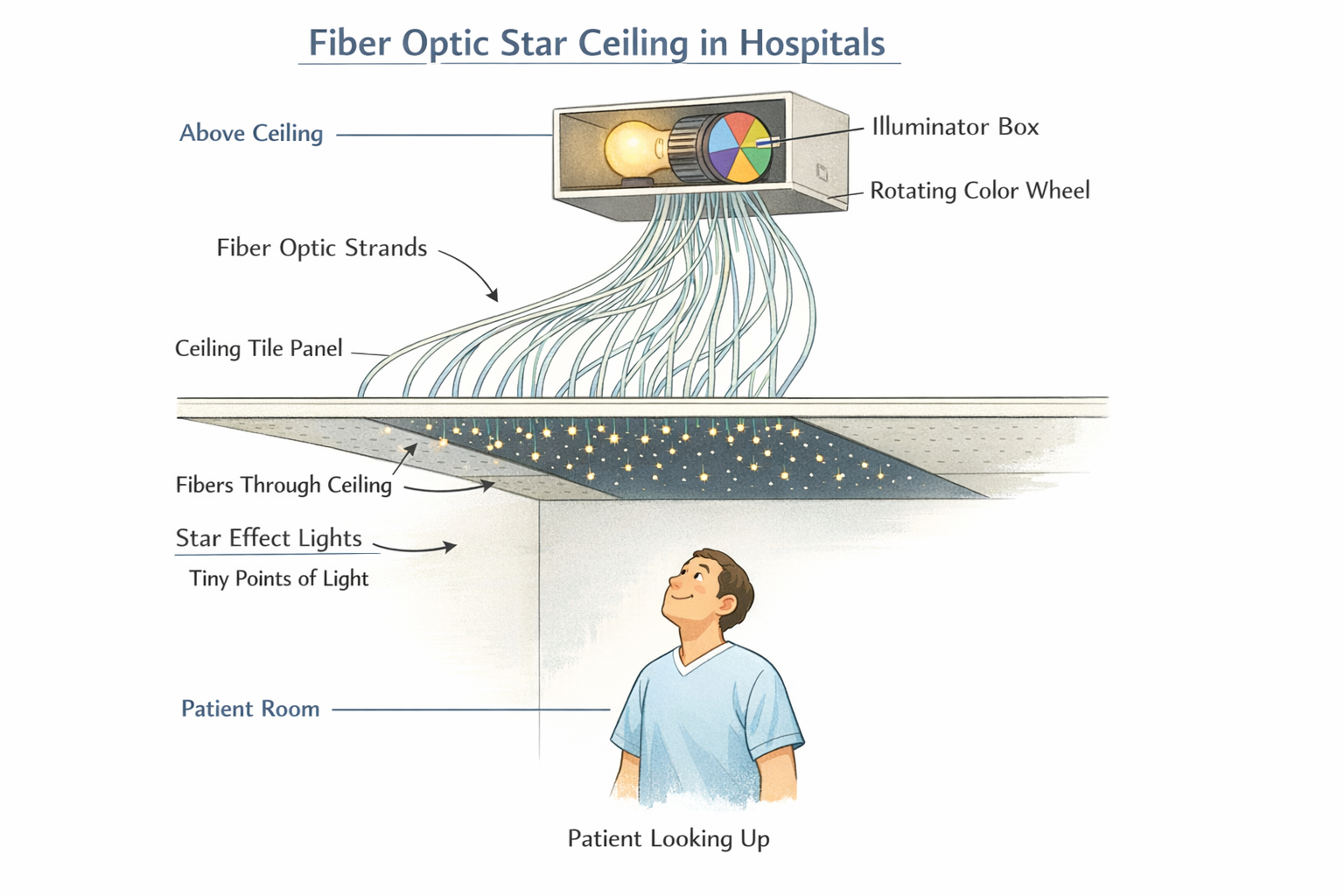
A single light source—usually an LED or halogen illuminator about the size of a shoebox—sits above the ceiling tiles, connected to dozens or even hundreds of hair-thin fiber optic strands. Each strand carries light from that central source to a tiny pinprick hole in the ceiling panel below. The fibers themselves don't generate any light or heat; they just pipe it from point A to point B. So what you see as a field of scattered stars is really one bulb, subdivided and distributed across the ceiling through glass threads thinner than a fishing line.
The twinkle effect comes from a wheel inside the illuminator box. It's literally a disc with cutouts that rotates in front of the light source, intermittently blocking different fiber bundles. Some systems use color wheels too, so the stars shift through soft blues and purples. It's mechanical, almost theatrical—less "advanced medical technology" and more "disco ball's gentler cousin."
The ceiling panels themselves are usually custom-made or modified. Some manufacturers sell pre-fabricated star panels with the fibers already embedded and polished flush to the surface. In other installations, technicians drill tiny holes through standard acoustic tiles and thread each fiber through by hand, securing them with a dot of adhesive on the back. The fibers get trimmed flush with the panel face, so from below you see only the illuminated dot, not the strand. The effect is seamless enough that it really does look like the panel itself is generating light, which is probably why you couldn't quite figure out what you were seeing.
Why go to all this trouble in a children's hospital? Partly distraction—a kid staring at a shifting starfield isn't watching the needle. But there's also something about making a medical space feel less clinical, less fluorescent-bright and anxiety-inducing. These ceilings show up in MRI rooms too, where patients have to lie still for extended periods, and in dental offices, anywhere someone might benefit from having something calm and mildly hypnotic to focus on overhead.
So the next time you find yourself in one of those rooms, you can picture what's happening above: a single bright eye, a spinning wheel, and a spray of glass whiskers carrying fragments of that light to every corner of the ceiling. One source, many stars.